
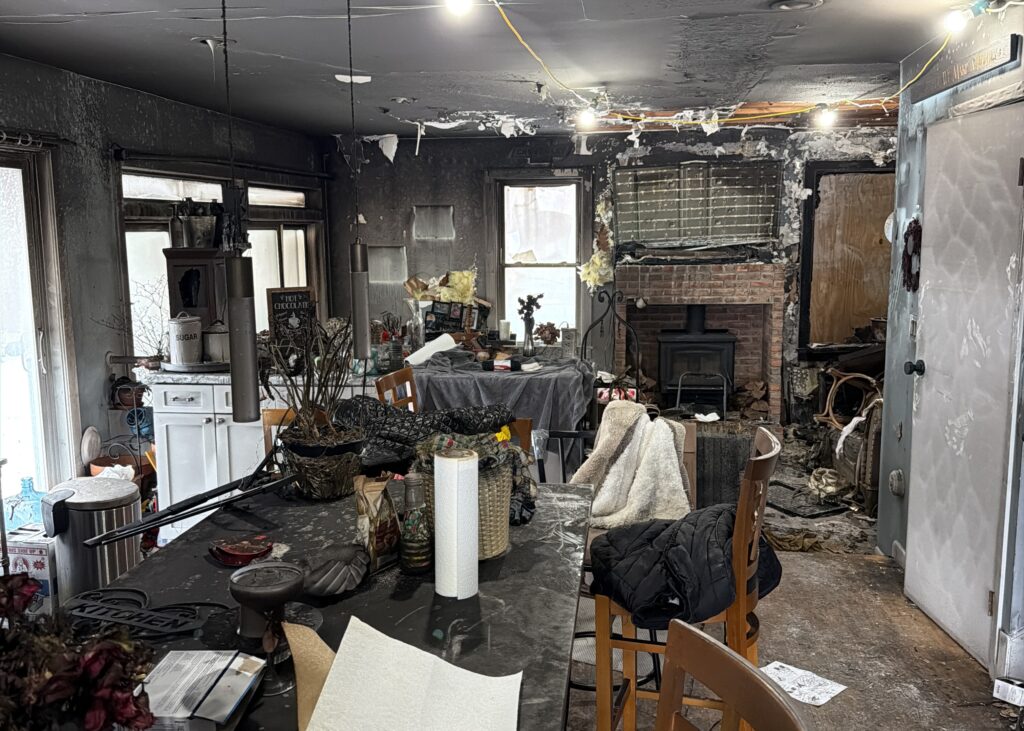
The fire trucks pull away. The neighbors go back inside. And you’re standing in your driveway looking at a house that doesn’t feel like yours anymore.
What happens next matters more than most homeowners realize.
The damage a fire causes doesn’t stop when the flames go out. Soot, smoke residue, and the thousands of gallons of water used to extinguish the fire keep working on your home long after the last engine leaves the block. What you do — and just as importantly, what you don’t do — in the first 48 hours can be the difference between a home that’s fully restored and one that carries permanent damage.
Here’s how to navigate that first day.
Hour 0–1: Safety Comes Before Everything
Do not re-enter your home until the fire department clears it. This isn’t a formality. Structures weakened by fire can fail without warning, and lingering carbon monoxide and superheated air pockets are invisible dangers. Floors, stairs, and roof structures may look intact and still be compromised.
Once you’re cleared to enter, keep it brief. Grab what you absolutely need — medications, identification, insurance documents, phones and chargers, a change of clothes for each family member, and anything irreplaceable that’s within easy reach.
Account for everyone, including pets. Animals hide when they’re frightened. Let the fire department know if a pet is unaccounted for.
Leave the utilities alone. Do not turn gas, electric, or water back on yourself, even if it seems fine. Fire compromises wiring and gas lines in ways that aren’t visible. Only a licensed professional or the utility company should restore service.
Hour 1–4: Make the Calls That Start Your Recovery
Call your insurance company and open a claim. The sooner your claim number exists, the sooner everything else can move. When you call, ask three specific questions:
- What does my policy cover for Additional Living Expenses (ALE)? This typically pays for a hotel, meals, and other costs while your home is uninhabitable — and many homeowners never file for it simply because they didn’t know to ask.
- Am I required to use a specific vendor, or can I choose my own restoration contractor? In New York, you have the right to choose.
- What documentation do you need from me, and by when?
Call a restoration company — not next week, today. Emergency mitigation work is time-sensitive, and reputable restoration companies operate 24/7 for exactly this reason. All Island Restoration responds around the clock throughout Nassau and Suffolk Counties.
Find somewhere to stay. If your home is uninhabitable, arrange lodging with family or a hotel. Keep every receipt from this point forward — lodging, meals, clothing, toiletries. These are frequently reimbursable under ALE coverage.
Notify your mortgage lender. Insurance settlement checks are often issued to both you and your lender, and starting that conversation early prevents delays later.
Hour 4–12: Document Everything
Your insurance claim will be built on evidence. Gather it before anything is cleaned, moved, or thrown away.
- Photograph and video everything, room by room, from multiple angles. Wide shots to establish each room, close-ups on individual damaged items.
- Do not discard damaged property until it’s been documented and your adjuster has had the opportunity to inspect it — even items that appear to be total losses.
- Start a written inventory of damaged contents: what it is, roughly when you bought it, what you paid. Receipts, credit card statements, and old photos of your home’s interior all help establish what you owned.
- Keep a claim log. Every phone call, every name, every date. When a claim runs long, this record becomes invaluable.
Hour 12–24: Prevent the Second Wave of Damage
Here’s what most homeowners don’t know: the fire may be the smaller half of the problem.
Soot is acidic. Within hours, it begins etching glass, discoloring grout, and corroding metal fixtures and appliances. Within a few days, that damage becomes permanent. Metals tarnish. Plastics yellow. Finished surfaces stain in ways that can no longer be cleaned out.
Smoke odor bonds to porous materials. Drywall, insulation, upholstery, carpet padding, and clothing absorb odor molecules that surface cleaning will never reach. Odor that isn’t professionally remediated tends to reappear months later, especially in humid weather.
Firefighting water creates a mold clock. Extinguishing a house fire can involve thousands of gallons of water, and it soaks into wall cavities, subfloors, and insulation. Mold can begin growing in as little as 24 to 48 hours. On Long Island, where summer humidity is high and many homes have basements and crawl spaces, this timeline can move quickly.
Your home needs to be secured. Broken windows, ventilation holes cut in the roof, and forced-entry doors leave your property open to weather, animals, and theft. Emergency board-up and roof tarping should happen within the first day.
What NOT To Do
These are the mistakes that turn recoverable damage into permanent loss:
- Don’t wipe or scrub soot yourself. Dry soot lifts with specialized chemical sponges and HEPA equipment. Wiping with a wet rag drives soot deeper into porous surfaces and permanently sets the stain.
- Don’t turn on HVAC. Running your heating or air conditioning circulates soot into every duct and room in the house, including areas the fire never touched.
- Don’t use appliances or electronics that were exposed to heat, smoke, or water until they’ve been evaluated.
- Don’t eat food exposed to fire, smoke, or firefighting chemicals — including sealed packages and canned goods, which can be compromised by heat.
- Don’t wash smoke-damaged clothing in your home machine. Improper washing sets odor and staining. Textiles need specialized cleaning.
- Don’t sign anything you don’t understand. Fires attract door-knockers. Read every agreement, and never sign over your insurance benefits to someone you didn’t research.
- Don’t wait to see how bad it is. Damage progresses. The window for preventing secondary damage is measured in hours, not weeks.
How All Island Restoration Helps
We’ve been serving Long Island families for over 30 years, across three generations. When you call us after a fire, here’s what we handle:
Emergency response, 24/7. We answer around the clock and mobilize to your property in Nassau and Suffolk Counties.
Board-up and roof tarping. We secure your home against weather, animals, and intrusion before anything else.
Water extraction and structural drying. We remove firefighting water and dry the structure with commercial equipment, monitoring moisture levels until your home is genuinely dry — not just dry to the touch.
Soot and smoke remediation. HEPA filtration, specialized cleaning methods matched to each surface type, and thermal fogging or hydroxyl treatment for odor that’s bonded to building materials.
Contents cleaning and pack-out. Furniture, clothing, electronics, documents, and personal belongings are inventoried, cleaned, and stored off-site while your home is restored.
Insurance coordination & Documentation. We will document the damage on your behalf, communicate directly with your adjuster, and work to ensure the scope of work reflects what your home actually needs.
Full reconstruction. This is where we differ from most companies you’ll call. Many restoration contractors handle mitigation only — they clean up and dry out, then hand you a list of general contractors and walk away. We rebuild. Framing, drywall, electrical, flooring, cabinetry, paint, and finish work. One company, one point of contact, from the emergency call to the day you walk back into a finished home.
We’re fully licensed in both Nassau & Suffolk counties, and we’re a family business, which means the people who answer your call are accountable for the work.
The Bottom Line
The first 48 hours after a residential fire are about three things: keeping your family safe, protecting your insurance claim, and stopping the damage from getting worse. You don’t have to figure it out alone, and you shouldn’t have to.
If you’ve experienced a fire at your Long Island home, call All Island Restoration now at 877-AIR-8070. We answer 24/7, we respond fast, and we stay with you through the rebuild.
📞 877-AIR-8070 🌐 allislandrestorationny.com 📍 Serving all of Nassau & Suffolk Counties
