Commercial Restoration in Yaphank, NY
Yaphank mixes a historic Main Street with Suffolk's civic machinery — the hamlet's small businesses and services along the Carmans River, the county campus's office concentration, operations at the laboratory's southern edge — and the spread writes varied losses: river-adjacent buildings with humid baselines, historic structures that dry on their own terms, modern office space with institutional documentation standards. Our crews carry all three briefs from one dispatch. Code triggers and ADA touchpoints get flagged in the first scope, not discovered mid-rebuild. Every day a business stays dark costs more than the repair itself, so the schedule is built backward from reopening.
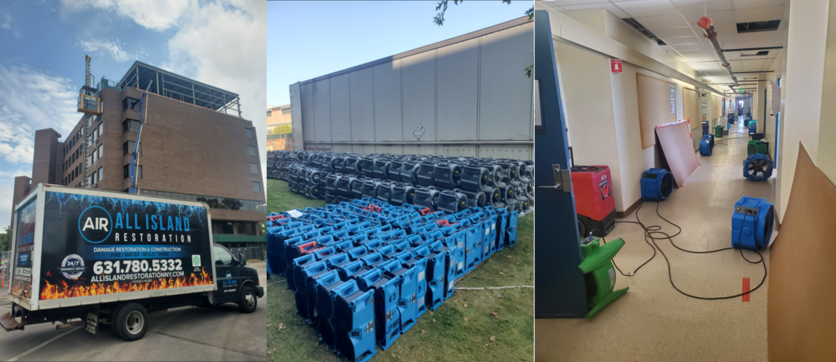
The documented spine runs around the clock — extraction, mapped moisture, logged drying, rebuild by our own crews. All Island Restoration carries Suffolk License #50966-H, IICRC certification, three generations of practice, and direct carrier billing throughout. One contract covers mitigation through rebuild, which keeps the claim file — and the timeline — in one set of hands. Work is phased around business hours wherever the building allows it, nights and weekends included. Documentation runs continuously, because a commercial claim is won or lost on the paper trail. Tenants, employees, and customers all read the response speed as a statement about the business itself.
Water, fire, mold or asbestos emergency? We answer 24/7 and bill your insurance directly.
877-AIR-8070Request a Free QuoteCommercial Buildings We Work On in Yaphank
Our Yaphank commercial calls span the whole inventory — office floors and professional practices, retail and restaurant space, medical and care facilities, schools and civic buildings, hospitality, and warehouse or light-industrial footage — and no two of those recover the same way. An office loss is a records-and-technology problem; a restaurant loss is a health-inspection problem; a warehouse loss is an inventory problem.
The method adapts to the occupancy while the spine stays fixed: documentation from the first hour, stabilization around the clock, and a rebuild by our own crews under one claim file.
Assessment to Reopening: The Process
We run Yaphank commercial losses in phases that respect an operating business: emergency stabilization at any hour, documentation from the first walkthrough, protection for records and inventory, then containment-separated cleaning and drying that lets unaffected sections keep working.
The same firm rebuilds — no gap between mitigation and reconstruction, no second contractor relearning the loss — and direct carrier billing means the schedule never waits on a settlement check.
Keeping Your Yaphank Business Open During the Work
A commercial loss has two clocks — the building's and the revenue's — and our Yaphank scopes answer both. Containment splits work zones from trading zones; loud phases book before opening or after close; drying runs unattended overnight; and the schedule is built backward from the reopening date, not forward from the damage.
Where full closure is unavoidable, the scope says so plainly and sequences the revenue spaces back first. Phased reopening behind containment is standard, with documentation supporting each partial inspection.
Documentation, Carriers, and Direct Billing
Commercial carriers scrutinize what residential carriers wave through — origin, duration, flood-versus-wind, pre-existing conditions — and our Yaphank documentation is built for that scrutiny from hour one: precise water lines, photo chronology, logged readings, line-item inventories.
We bill the carrier directly and keep owner, tenant, and interruption claims on separate files where they coexist. The work never waits on the settlement, and the settlement never waits on missing paper.
Main Street, the River, and the County Campus
Coverage spans Yaphank's commercial addresses from the historic hamlet to the county offices, stabilization through documented reopening. The references below frame the local ground. Dispatch answers day and night, and every phase ends with sign-off the carrier accepts. Estimates are free at any hour, and phased schedules keep open sections operating while work proceeds. Assessment costs nothing, response runs 24/7, and every closed area reopens behind a documented inspection.
- Yaphank, New York — The hamlet's record and the river hamlet its commerce fills.
- Carmans River — The river carries the moisture baseline we scope against.
- Brookhaven National Laboratory — The laboratory's campus anchors the territory's north gravity.
- Middle Island — Middle Island's corridor extends the coverage north.
Frequently Asked Questions
River-adjacent building, chronic damp, now real flood damage. Where does the claim start?
At the event — we document the flood's water lines distinctly from the baseline, exactly the separation the carrier will ask about.
Historic Main Street building. Dry or demolish?
Map first — old fabric dries and restores under controlled method, and the assessment separates restorable from replaceable.
Can we trade during the work?
Usually — containment, after-close loud phases, equipment out of the customer path.
Who bills the carrier?
We do, directly, from the first visit.
Is the estimate free?
Yes — any hour at 877-AIR-8070.
This page is part of our commercial restoration service area: Commercial Restoration on Long Island · Water Damage Cleanup in Yaphank, NY · Fire & Smoke Damage Restoration in Yaphank, NY · Puffback & Soot Cleaning in Yaphank, NY.