
Commercial Restoration in Islip, NY
Islip hamlet's Main Street carries the town seat's commerce — restaurants and retail in storefront blocks, professional and legal suites serving the town hall's gravity, marine businesses working the creeks toward the bay — in buildings that mix Victorian survivors with postwar fill. Mixed-age blocks mean mixed failure patterns, and our assessment reads each building honestly before the scope gets written: what it's made of decides how it dries. A commercial loss has two clocks — the building's and the revenue's — and our scope answers both. The sooner containment goes up, the smaller the portion of the building that joins the claim.
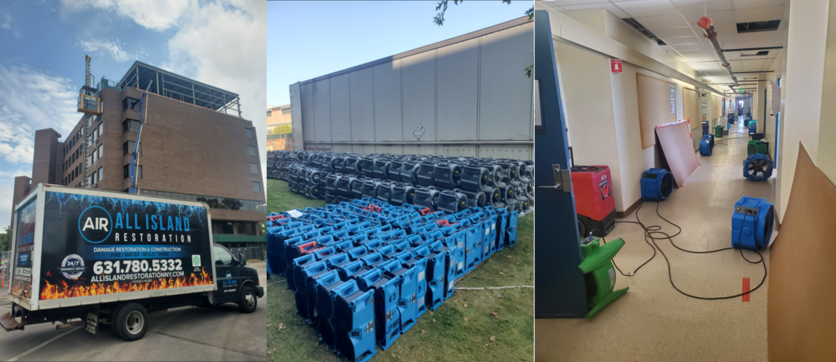
The response is around-the-clock with the documented spine — extraction, meter mapping, logged drying, contents line items, rebuild by our own crews. All Island Restoration carries Suffolk License #50966-H, IICRC certification, three generations of South Shore practice, and direct carrier billing throughout. Code triggers and ADA touchpoints get flagged in the first scope, not discovered mid-rebuild. Every day a business stays dark costs more than the repair itself, so the schedule is built backward from reopening. The estimate separates what insurance carries from what the business decides, so owners choose with real numbers.
Water, fire, mold or asbestos emergency? We answer 24/7 and bill your insurance directly.
877-AIR-8070Request a Free QuoteFrom Storefronts to Warehouses in Islip
From a two-chair practice to a distribution floor, Islip's commercial stock all lands on the same emergency line — and gets format-matched response. Offices need records and technology protected first; medical occupancies need air standards and clearance documentation; retail needs the selling floor back; industrial needs equipment triage and volume drying.
What every format shares: per-tenant documentation where leases stack, direct carrier billing, and one firm carrying the job from stabilization through rebuild.
Assessment to Reopening: The Process
We run Islip commercial losses in phases that respect an operating business: emergency stabilization at any hour, documentation from the first walkthrough, protection for records and inventory, then containment-separated cleaning and drying that lets unaffected sections keep working.
The same firm rebuilds — no gap between mitigation and reconstruction, no second contractor relearning the loss — and direct carrier billing means the schedule never waits on a settlement check.
Keeping Your Islip Business Open During the Work
A commercial loss has two clocks — the building's and the revenue's — and our Islip scopes answer both. Containment splits work zones from trading zones; loud phases book before opening or after close; drying runs unattended overnight; and the schedule is built backward from the reopening date, not forward from the damage.
Where full closure is unavoidable, the scope says so plainly and sequences the revenue spaces back first. Phased reopening behind containment is standard, with documentation supporting each partial inspection.
Commercial Insurance Claims in Islip: How We Handle Them
A commercial claim is won or lost on documentation, so ours starts at the first Islip walkthrough: origin and path records, moisture logs or soot typing, line-item contents and inventory files, and photos tied to each phase of the work. The carrier gets a file built the way carriers review.
We bill the insurance directly, which means recovery starts on the damage date instead of the settlement date — and where owner and tenant claims both exist, each gets its own clean file so neither waits on the other.
Main Street and the Creek Roads
Coverage spans Islip's commercial addresses from the Main Street row to the bay-side operations, stabilization through documented reopening. The references below frame the local ground. The walkthrough is free, the emergency line never closes, and reopening dates are set in the first scope. Free commercial assessments, around-the-clock response, and direct carrier billing come standard. One call scopes it; a documented, section-by-section handback finishes it.
- Islip (hamlet), New York — The hamlet's record and the Main Street it centers on.
- Seatuck National Wildlife Refuge — The refuge marks the bay edge of the territory.
- Fire Island — Seasonal south-shore operations sit inside the zone.
- East Islip — East Islip's businesses extend the coverage east.
Frequently Asked Questions
Our Main Street building is a Victorian. Can it be dried without gutting?
Usually — old framing and plaster dry well under controlled method: mapped moisture, gentle pace, logged readings. The free assessment separates restorable from replaceable before anything is cut.
Can our law office stay open during restoration upstairs?
Typically yes — containment isolates the loss, air gets monitored, and client-facing space stays presentable.
Marine business near the creek took storm water. Who sorts flood versus wind?
The documentation — water lines, origin, and paths recorded from the first visit, which is exactly what settles that carrier question.
Who bills the insurance?
We do, directly, with the file built as the work runs.
What does assessment cost?
Nothing — free estimate any hour at 877-AIR-8070.
This page is part of our commercial restoration service area: Commercial Restoration on Long Island · Water Damage Cleanup in Islip, NY · Fire & Smoke Damage Restoration in Islip, NY · Puffback & Soot Cleaning in Islip, NY.